
German Shepherd Training: Puppy Routine, Week 8 to 16
In this article
German shepherd training starts with small household jobs, not a long list of commands: answering to their name, a calm handoff at the door, walking into a crate by choice. Teach one at a time with rewards, and plan the rest of the day around potty breaks and naps that are the same as any other puppy's.
That last part surprises people. A German shepherd puppy will grow into a 50 to 90 pound dog, but at 10 weeks their bladder, sleep needs and attention span are a puppy's. Bigger does not mean longer potty gaps or more exercise. This guide gives you the week-by-week routine from 8 to 16 weeks, crate size numbers for a growing shepherd, and how to handle the three things shepherd owners ask about most: mouthing, herding nips and alarm barking.
How to train a German shepherd puppy at home
To train a German shepherd puppy, pick one small household skill, reward it in a quiet room, and only then make it harder. Short, reward-based sessions of a few minutes beat long ones. Every person in the house should start from the same step. Our puppy training tips cover the marker word, lure fading and treat choice that work for any breed.
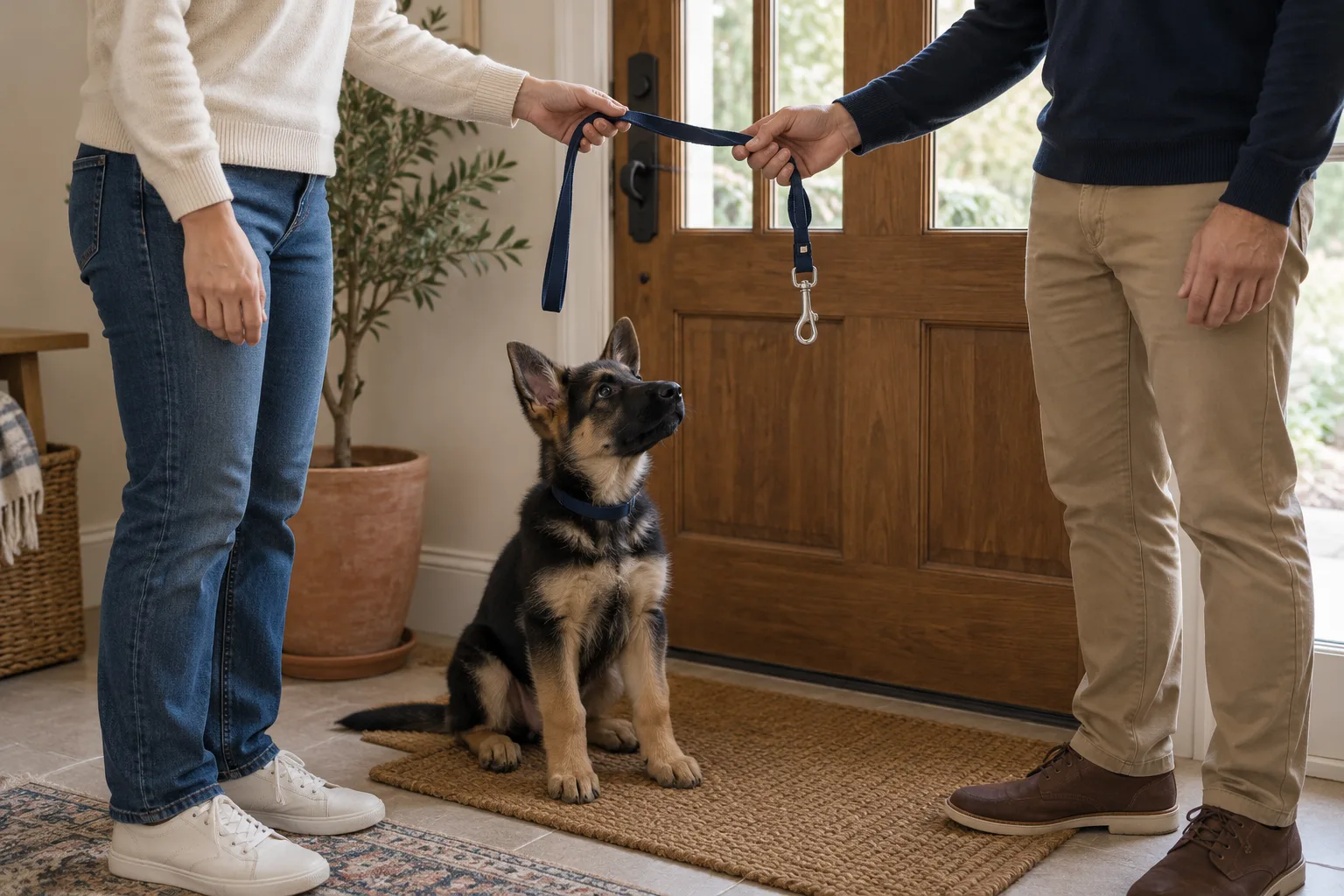
Good first skills are a response to the puppy's name, a calm handoff at a doorway, and walking into a resting space by choice. You do not need a long command list to make tomorrow easier. Write one small goal and show the other caregivers what it means.
The AKC German shepherd training timeline puts weight on early, ongoing learning and positive exposure to daily life. Use that as a reason to practice ordinary household moments, not to rush milestones. Let your puppy watch everyday activity from a comfortable distance and move away when they want. Ask your vet about safe exposure where you live.
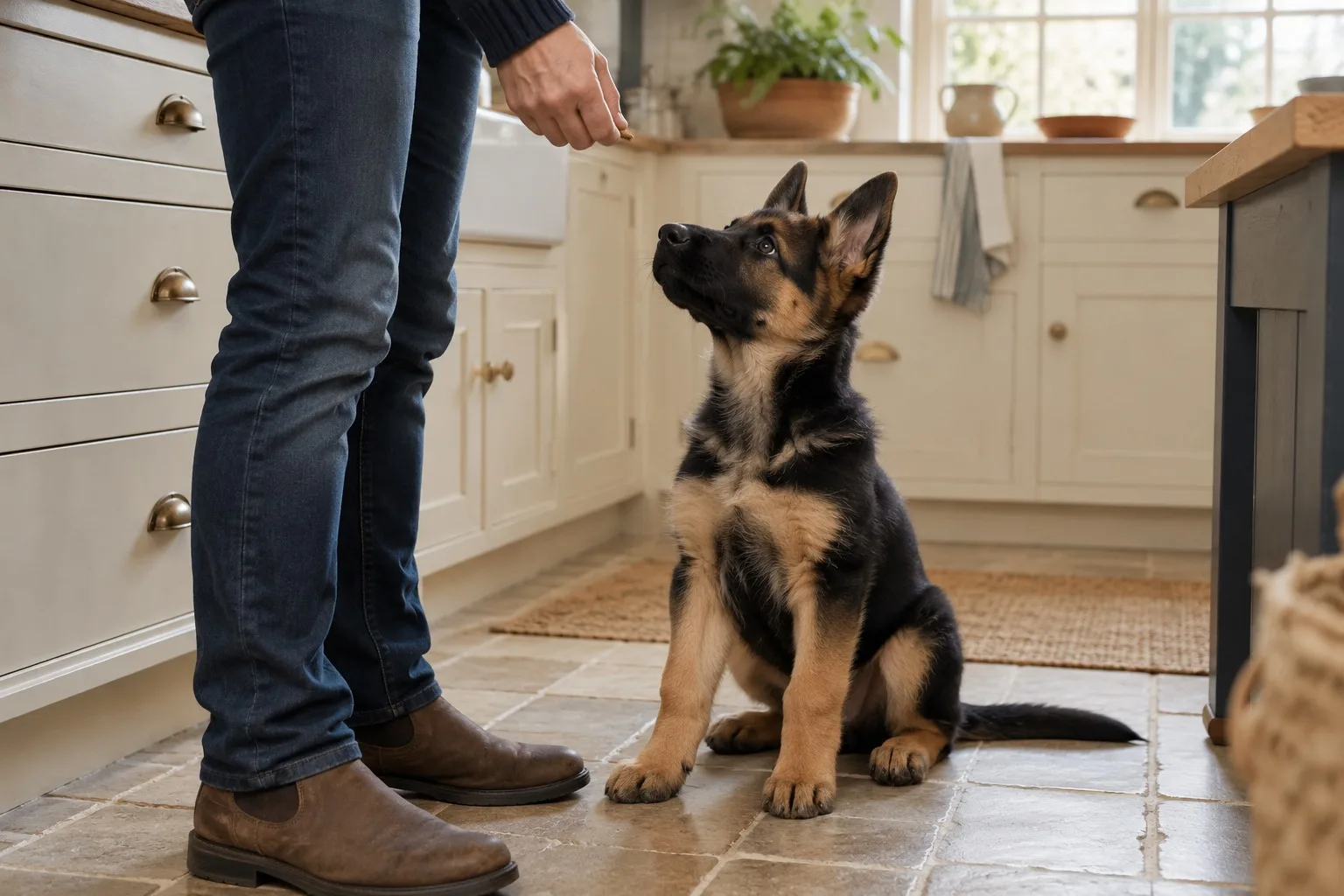
Use a short, clear cue for the name game so everyone says it the same way.
Say it once, reward the moment your puppy looks at you, and stop after a few easy wins.
How to train a German shepherd puppy, step by step
- Choose one household skill
Pick a small goal, like looking toward you when you say their name. Get treats ready and choose a quiet room. Show every caregiver the same starting step.
- Practice with an easy exit
Reward a voluntary response and let your puppy wander off or go back to a toy. Keep sessions to a few minutes. Ask your vet about exercise and exposure limits for your growing puppy.
- Fit practice around care
Use the week-by-week table below as a starting point and note what your puppy actually needs. Cover potty trips, naps and handoffs between people first.
- Make it a little harder
Once the easy version works most times, change one thing: a different room, a second person nearby, or a short distance. If it falls apart, go back a step.
German shepherd puppy routine: every week from 8 to 16
The numbers for a German shepherd puppy are the same as for any other puppy of the same age. Puptoday's large-breed adjustments are currently zero, because a larger puppy does not automatically hold it longer. Treat this as a rule of thumb, not a target, and go sooner whenever your puppy signals.
| Age | Awake potty reminder | Awake crate practice | Sleep per day | Planned night stretch |
|---|---|---|---|---|
| 8 weeks | 90 minutes | 20 minutes, only while comfortable | 18 to 20 hours | 150 minutes |
| 9 weeks | 105 minutes | 25 minutes, only while comfortable | 18 to 20 hours | 165 minutes |
| 10 weeks | 120 minutes | 30 minutes, only while comfortable | 18 to 20 hours | 180 minutes |
| 11 weeks | 135 minutes | 35 minutes, only while comfortable | 18 to 20 hours | 195 minutes |
| 12 weeks | 150 minutes | 40 minutes, only while comfortable | 18 to 20 hours | 210 minutes |
| 13 weeks | 165 minutes | 45 minutes, only while comfortable | 18 to 20 hours | 225 minutes |
| 14 weeks | 180 minutes | 50 minutes, only while comfortable | 18 to 20 hours | 240 minutes |
| 15 weeks | 195 minutes | 55 minutes, only while comfortable | 18 to 20 hours | 240 minutes |
| 16 weeks | 210 minutes | 60 minutes, only while comfortable | 18 to 20 hours | 240 minutes |
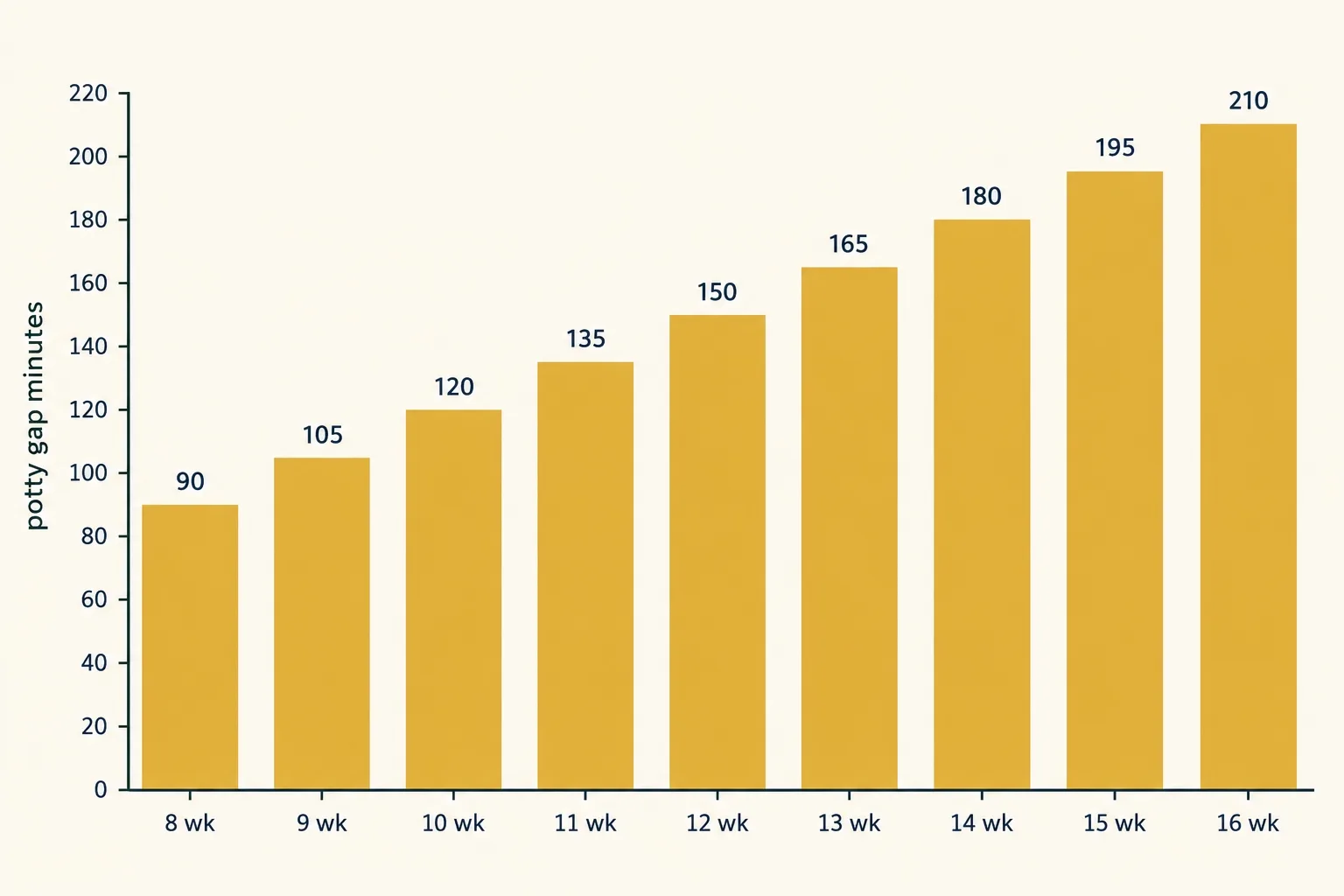
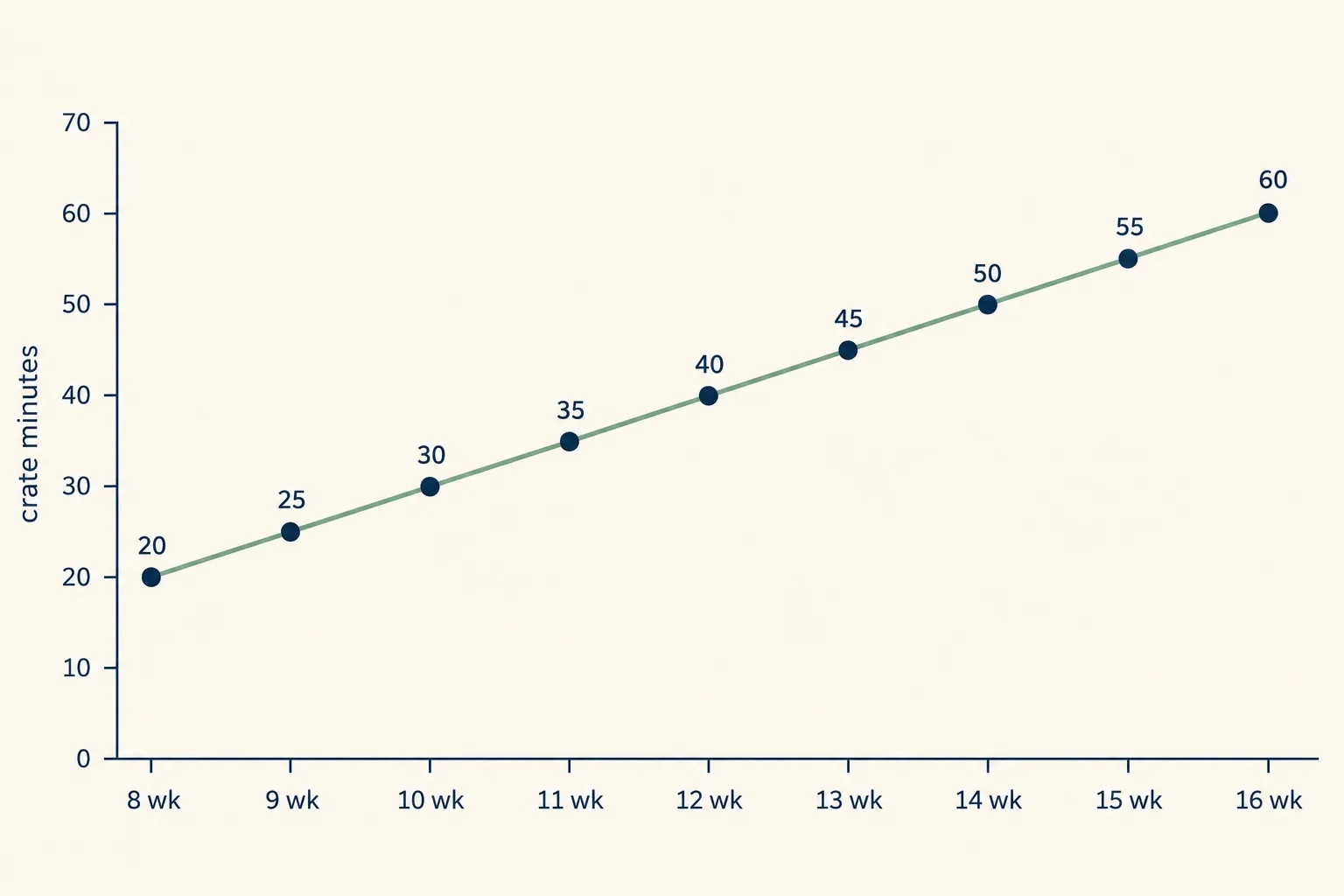
The potty gap grows by 15 minutes a week, from 90 minutes at 8 weeks to 210 at 16. Crate practice grows by 5 minutes a week, from 20 to 60. Start crate practice with a moment of comfort, never with the full number in the table.
For a full day with clock times, compare the 8 week old puppy schedule and the 12 week old puppy schedule. Session times are example practice budgets, not developmental targets. Confirm feeding with your vet.
Meet the German shepherd puppy in front of you
Adult size is useful for planning a crate and your home. It tells you nothing about what your puppy can do today.
| Fact | What it says | Source |
|---|---|---|
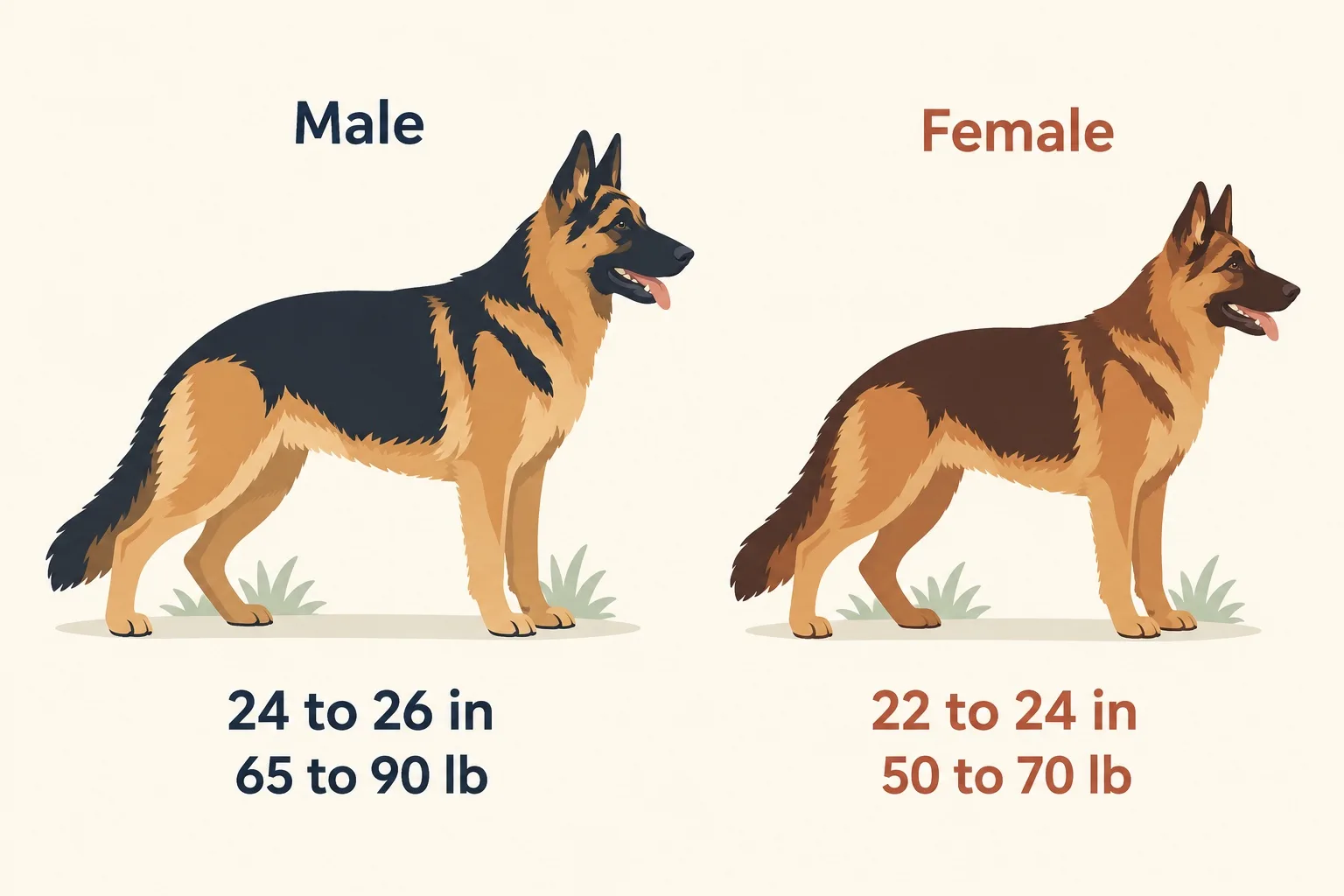
| Adult height at the shoulder | Males 24 to 26 inches, females 22 to 24 inches | AKC breed standard |
| Adult weight | Males 65 to 90 pounds, females 50 to 70 pounds | AKC breed profile |
| Size class | Large: 51 to 100 pounds in the plan generator | Puptoday planning rules |
| Energy | High energy in the adult breed profile; puppy activity needs individual guidance from your vet | AKC breed profile |
| Puppy challenges to plan for | Mouthing, nipping around moving people, alarm barking | AKC training timeline |
Mouthing and herding nips around moving people
German shepherd puppies often nip at moving feet and clothing, which is normal puppy mouthing that herding breeds do with extra enthusiasm. Manage it with a toy and a gate before the busy moment, not with corrections after it.
Treat a busy hallway as a setup to change, not proof that your puppy has a breed problem. The AKC breed training resource talks about appropriate outlets and impulse control. Start by watching exactly when the nipping happens.
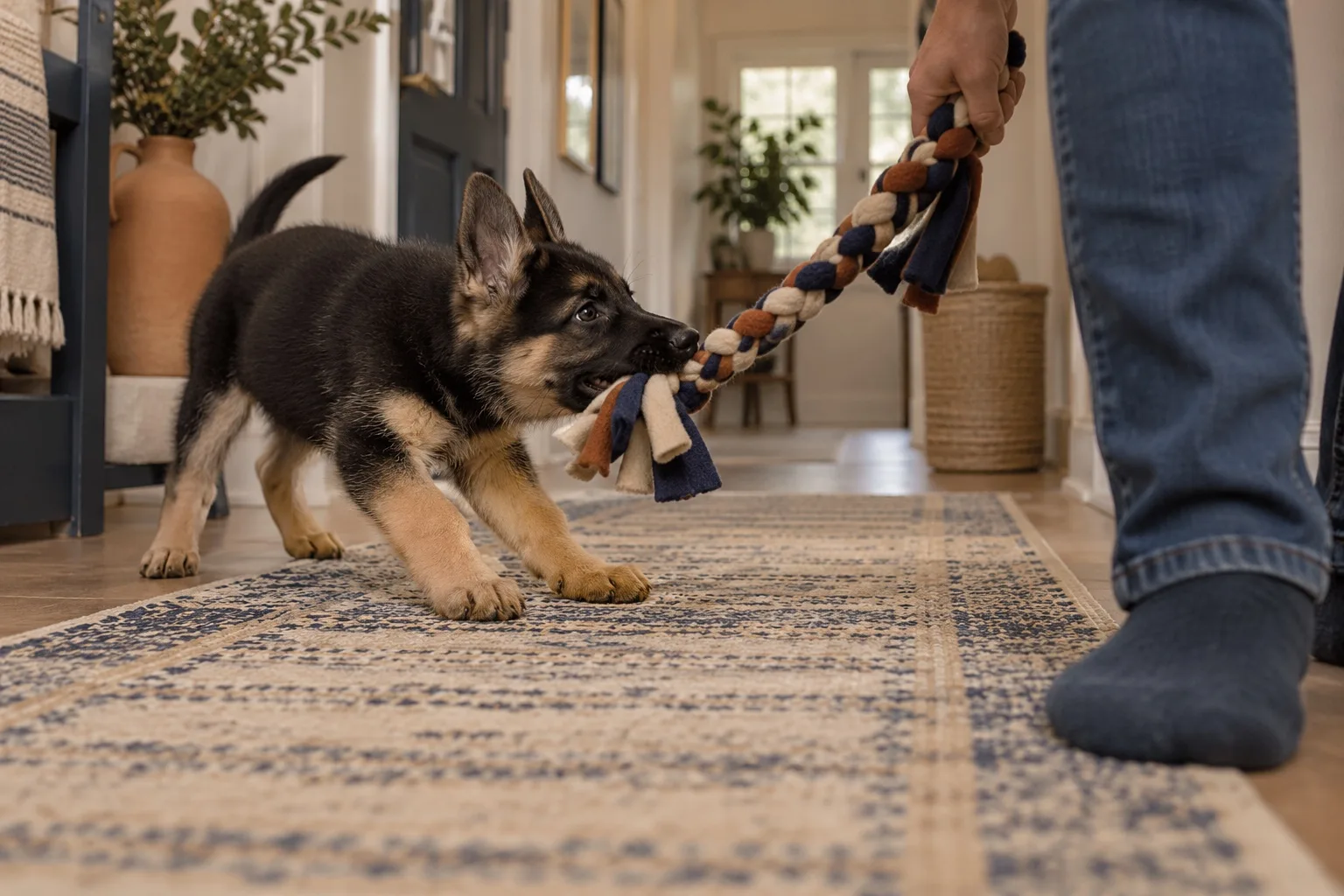
Before a busy transition, get a long toy ready and a gate if needed. Have one adult guide the puppy into a toy game while others walk through. Do not turn it into a chase. If teeth reach skin, pause the game and set up a calmer version. Children should never be responsible for teaching the puppy through difficult contact.
The how to stop puppy biting guide covers toy-first play and chew choices in detail. Puppy mouthing is normal, but any bite that breaks skin on a person, or any aggression, needs a certified behavior professional. Do not recreate an unsafe moment to see whether your puppy has improved.
Alarm barking: make the next household sound manageable
Notice which event sets your puppy off: the door, footsteps outside, someone passing the window. Write it down before deciding what to practice. Then set things up so your puppy can notice it without being overwhelmed, for example by moving farther from the window or using a quieter room for the next short session.
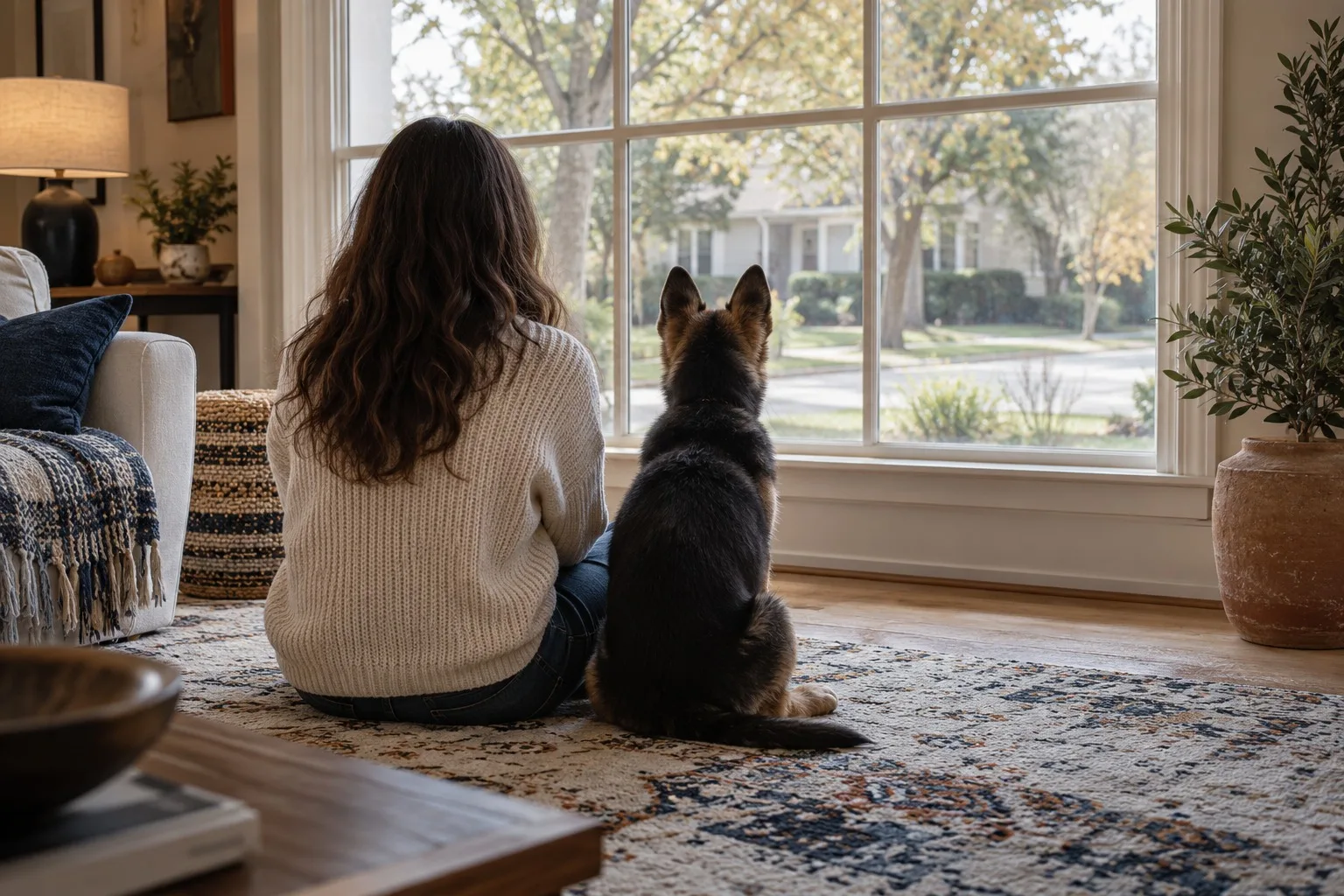
The AVSAB position statements support reward-based learning and good socialization. Reward a manageable response you can see, such as looking back at you or going back to a toy. Do not stage crowds or repeated loud surprises to test your puppy.
Decide who handles the next delivery before the doorbell rings. One adult manages the door while another stays with the puppy. That split of jobs beats trying to teach something new while everyone rushes to answer.
Exercise limits for a growing German shepherd
A German shepherd puppy does not need adult-sized exercise. The AKC describes a high-energy working breed, but that adult picture is not a safe plan for a growing puppy. Ask your vet about exercise limits while your puppy develops.
Do not build running, jumping or walking targets from adult weight, expected height or a minutes-per-month formula. For today, fit gentle learning and ordinary care into short sessions you can watch: a quiet name game, supervised exploring, a toy game. Then a nap. Use the puppy sleep schedule to protect those naps from household traffic.
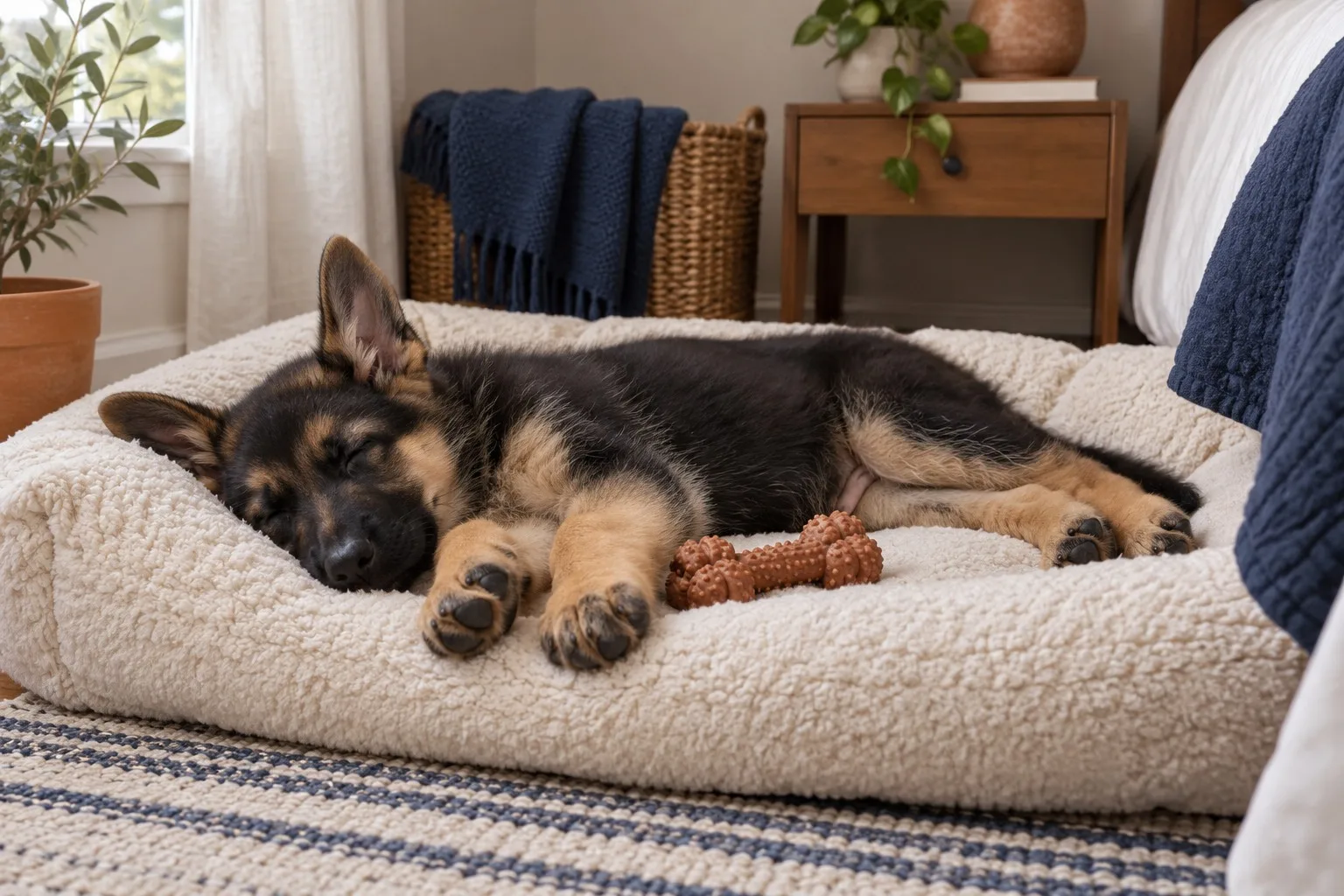
If you notice limping, discomfort or a puppy suddenly unwilling to join in, contact your vet rather than adding more exercise.
German shepherd crate size: what to buy for a growing puppy
Measure your puppy, not the breed. Crate length should be your dog's nose-to-tail-base length plus about 4 inches, and height should be the floor to the top of the head or upright ears plus 2 to 4 inches. For a growing shepherd, buy for the adult and use a divider now.
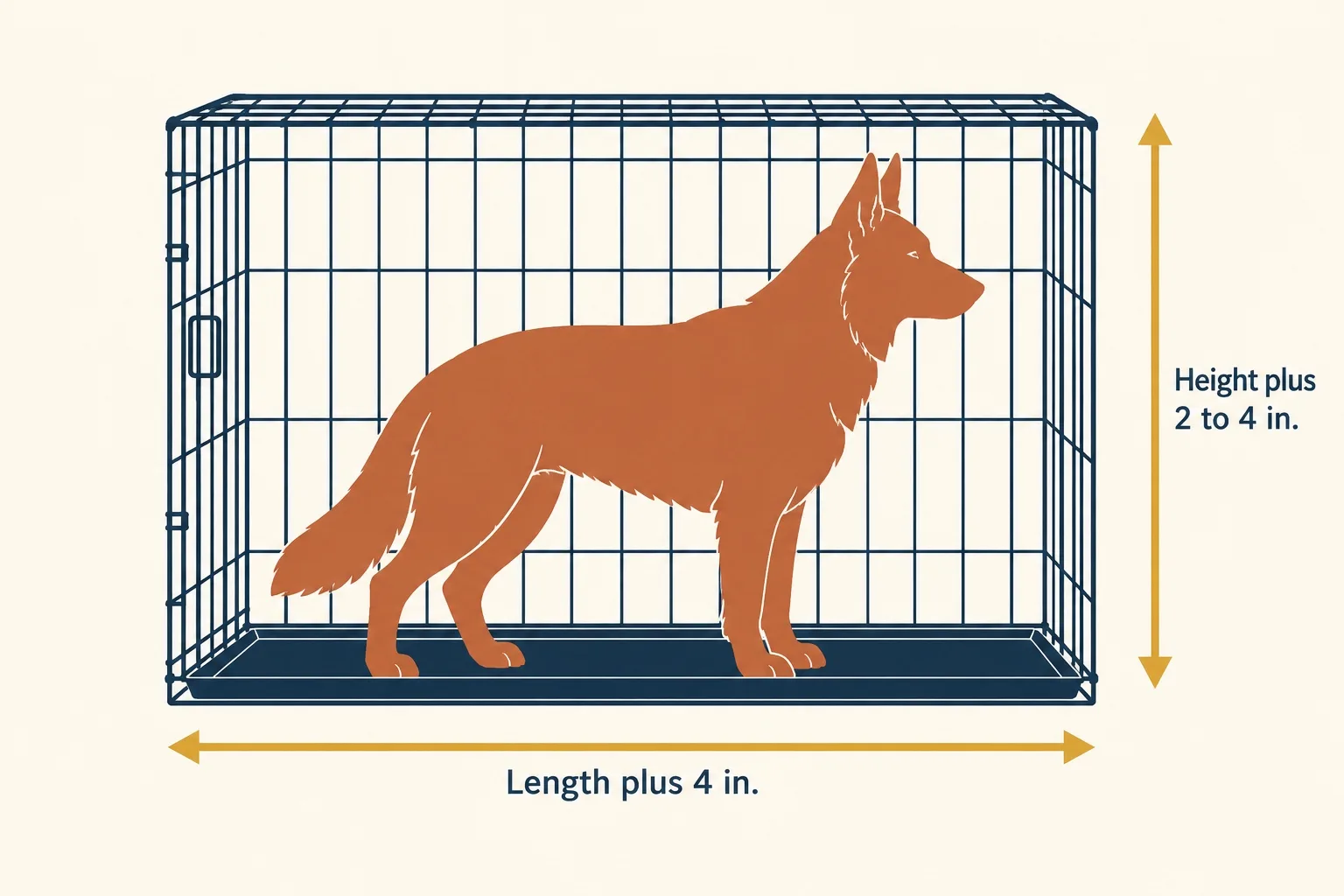
The German shepherd crate size calculator compares your measurements against a shortlist of common lengths. It picks the first length that reaches your dog's length plus 4 inches.
| Your dog's measured length | Plus 4 inches | First shortlist size that fits |
|---|---|---|
| Up to 20 inches | Up to 24 inches | 24 inch |
| 21 to 26 inches | 25 to 30 inches | 30 inch |
| 27 to 32 inches | 31 to 36 inches | 36 inch |
| 33 to 38 inches | 37 to 42 inches | 42 inch |
| 39 to 44 inches | 43 to 48 inches | 48 inch |
| Over 44 inches | Over 48 inches | Shortlist too small, check larger crates |
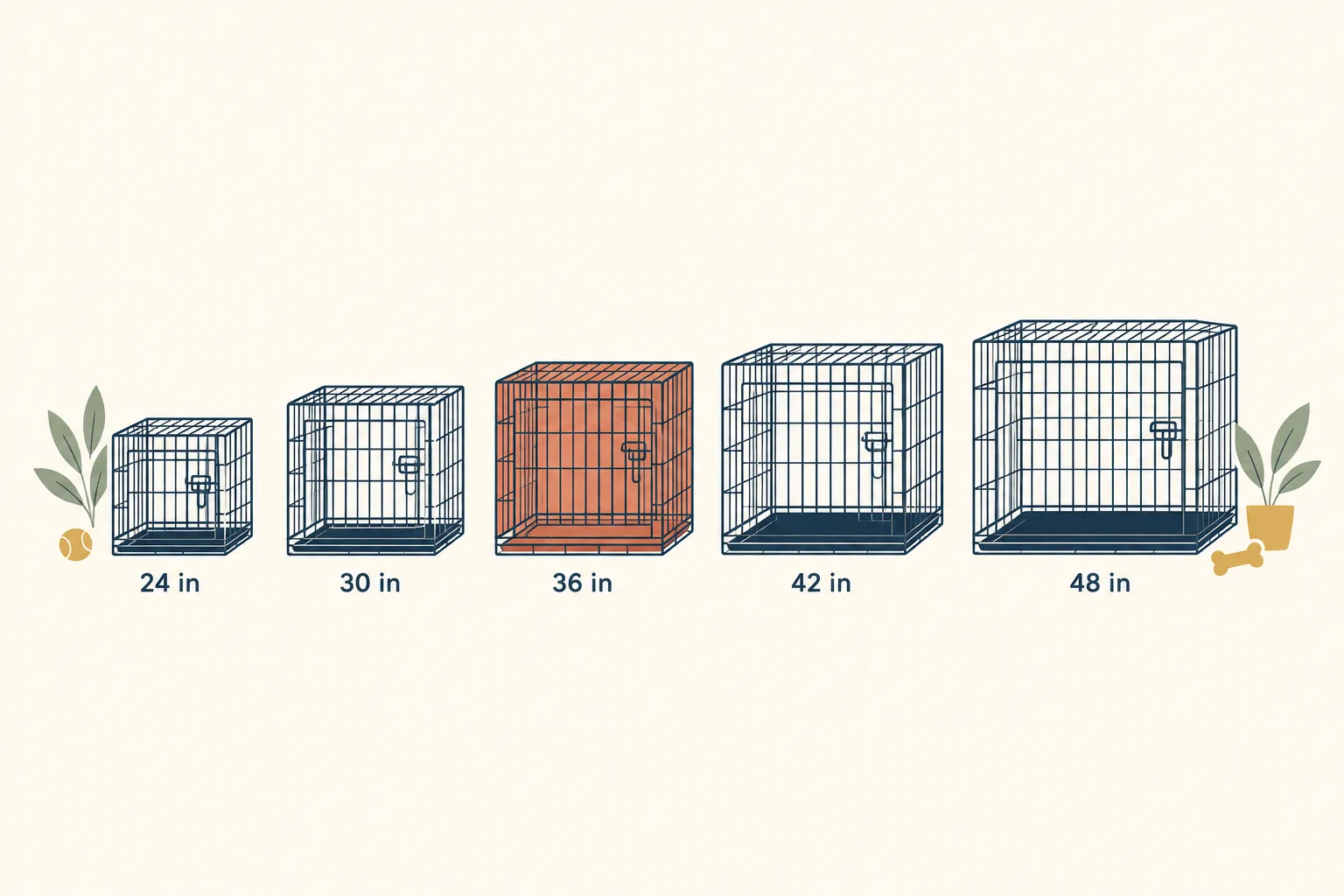
The calculator's worked example: a dog 32 inches long and 26 inches high needs about 34 to 36 inches of inside length and 28 to 30 inches of inside height, so you compare 36 inch crates and then check the interior height and width. A product name may describe outside size, and a thick bed takes space too. The AKC standard lists shoulder height, not height to the ears, so a breed label alone cannot pick the crate.
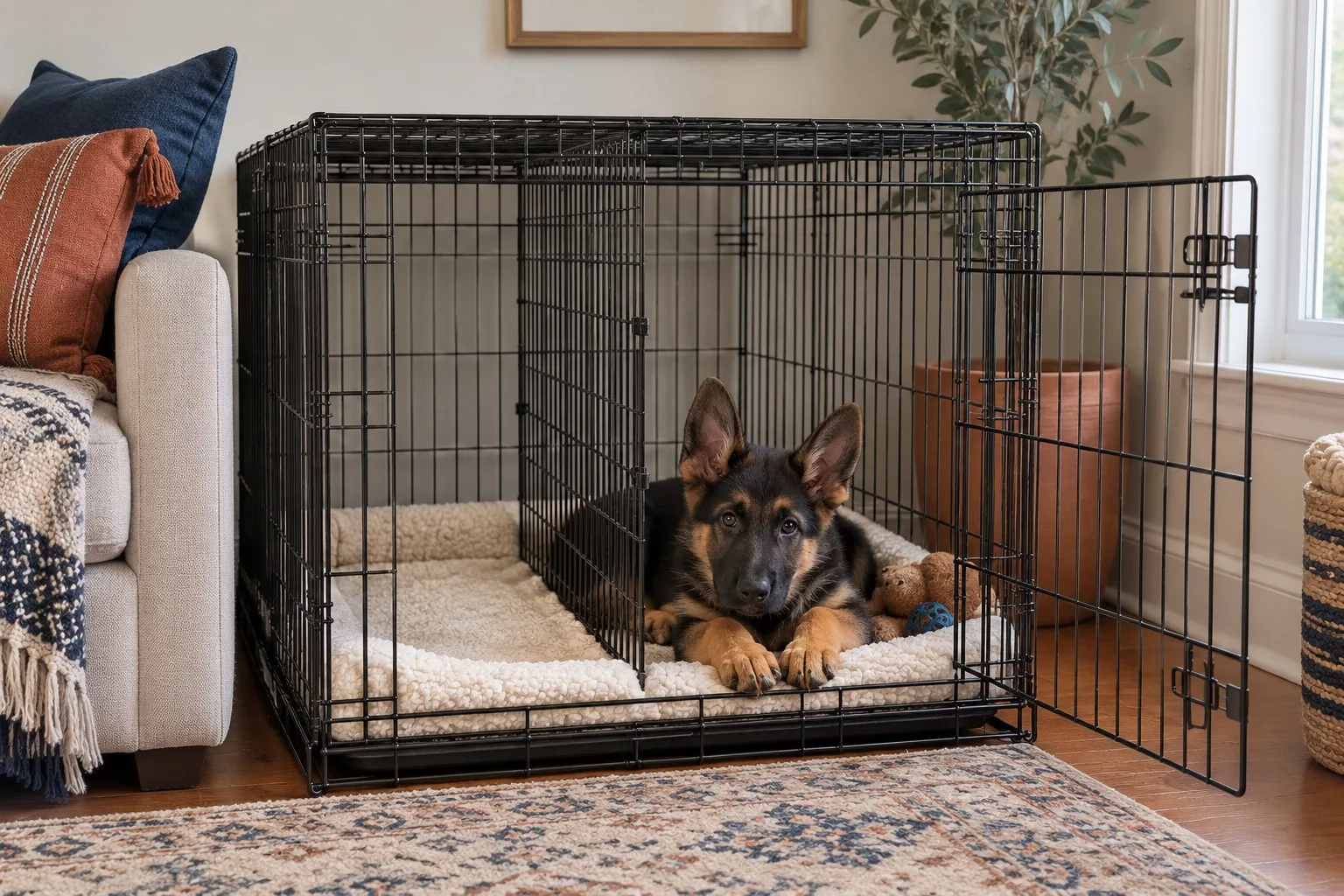
Size is only half of it. The calculator will not tell you how long your puppy can stay inside. Follow the crate training steps for that separate skill, start with a comfortable moment rather than the full table interval, and arrange a person for any workday gap. A bigger crate cannot replace a missed break or company.
Mistakes that slow German shepherd training
- Assuming a big body means a big bladder. Potty gaps follow age, not breed size.
- Planning adult exercise for a puppy. Ask your vet about limits during growth.
- Letting children manage nipping. An adult supervises, every time.
- Teaching a new skill at the busiest doorway. Start in a quiet room, then move.
- Waiting for a calming-down age. Teach calm alternatives now instead of waiting while an unsafe pattern continues.
- Harsh corrections. They add stress and slow learning. Reward the behavior you want.
If training stress comes with health changes, check the list below.
The short version
German shepherd training at 8 to 16 weeks is ordinary puppy training done consistently: one small skill at a time, rewards, short sessions, and a day built around potty gaps that grow from 90 to 210 minutes. Buy the crate for the adult, use a divider now, and ask your vet before adding exercise.
The free method works. Where it gets hard is keeping a growing shepherd's day straight: when the next potty trip is due, how long today's crate practice should be, and what to change after a rough evening of nipping. Build a free schedule for your puppy's age and set the size to large. It lays out naps, potty trips and practice for this week.
Get tomorrow's plan, adapted to how today went.
Frequently asked questions
Start with one small household skill, like responding to their name, and reward it in a quiet room for a few minutes at a time. Add difficulty slowly, one change at a time. Build the day around potty trips and naps, and get a reward-based professional involved if something stays hard.
It depends on the puppy, the task, your home and the help you have. A breed reputation is not a guarantee either way. Pick one manageable goal, set up the room so success is easy, and reward voluntary responses.
There is no birthday that guarantees a calmer dog. Keep teaching calm alternatives now and look at the situations that tip your puppy over. Ask your vet about activity as your puppy grows and get professional support for ongoing behavior concerns.
Measure your dog's nose-to-tail-base length and add about 4 inches, and measure height to the top of the head or ears and add 2 to 4 inches. Plan for adult size and use a divider while your puppy is small.
Do not force difficult interactions, make every session harder, or treat adult breed traits as instructions for a puppy. Never recreate a bite situation to test your puppy. For broken skin on a person or aggression, get a certified behavior professional.
No. Choose cues everyone in your house can say the same way, in any language. A few clear cues with good reward timing matter more than a long vocabulary.
Get tomorrow's plan, adapted to how today went
A printed schedule can't see that she peed at 7:10 today; the Coach plan rewrites tomorrow from today's log. Start with the free schedule for your puppy.
Build my puppy's plan- Free starting schedule
- Reward-based practice
- Fits your puppy's day
Share article
About the author
More articles
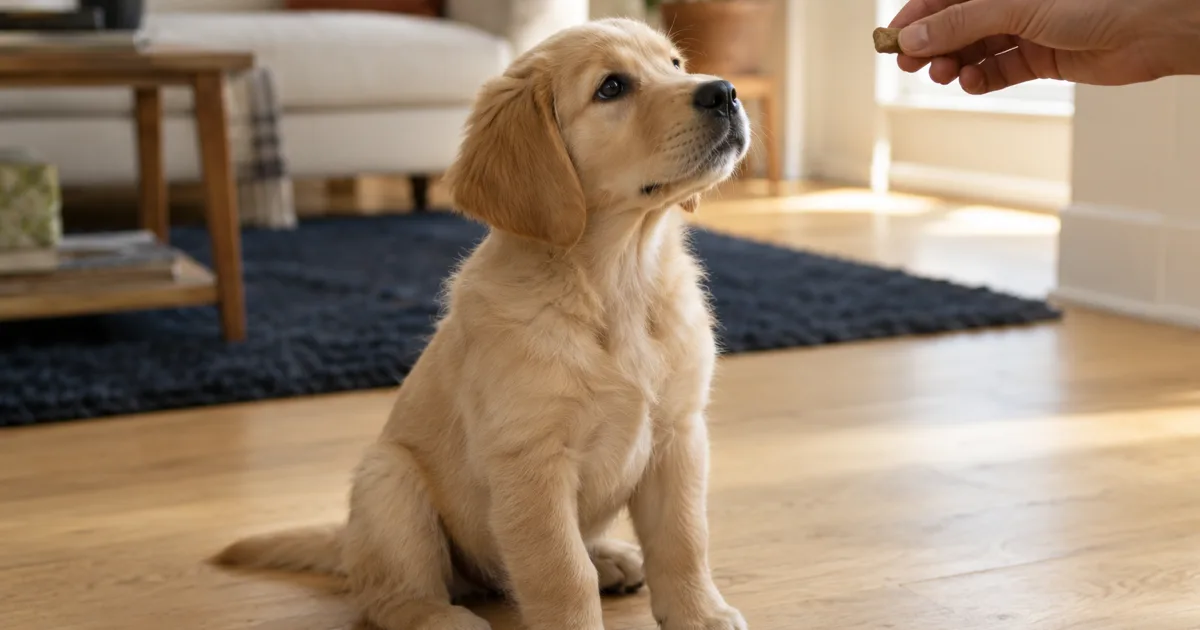
Training that sticks · 12 min
Puppy Training Tips: 9 That Work in 3-Minute Sessions
Nine reward-based puppy training tips in order of payoff: 3 minute sessions, a one-second marker, fading the lure, better treats for harder places, and what to teach from 8 to 20 weeks.
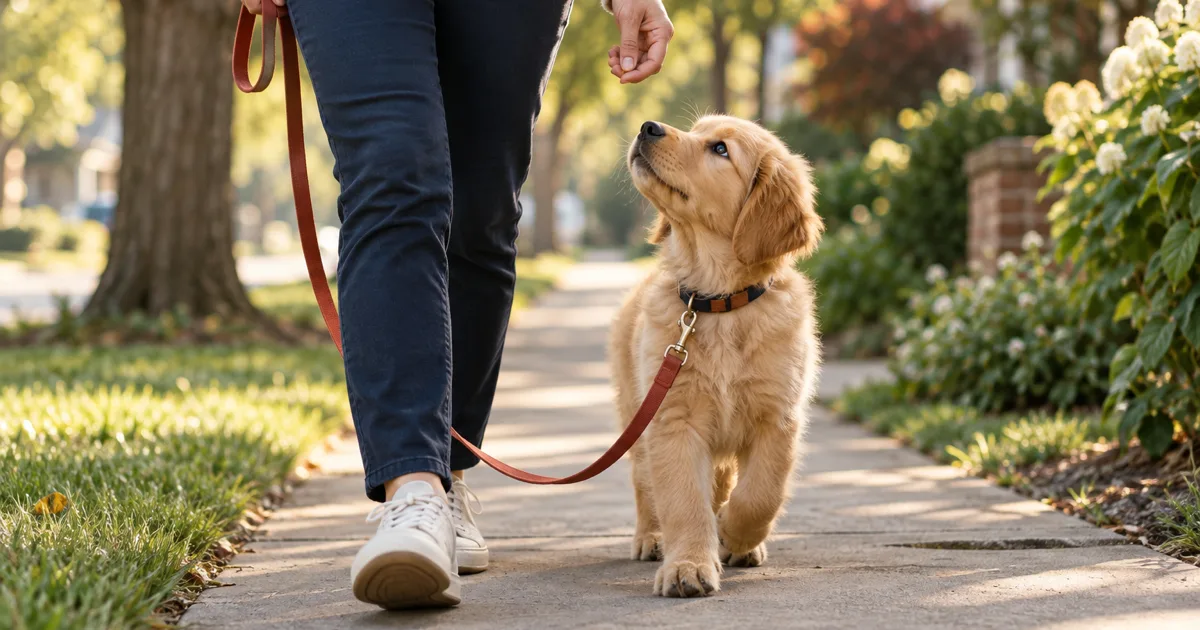
Training that sticks · 12 min
Leash Training a Puppy: 6 Steps From the First Week Home
Leash training a puppy in short indoor sessions from 8 weeks: the gear to pick, where the reward goes, the stop-and-go rule for pulling, and fixes for a puppy who sits, bites the leash or lunges.
Training that sticks · 11 min
Puppy Socialization: A Calm Checklist for Real Life
Help your puppy feel safe around people, sounds and new places. Use this gentle checklist, comfort signals and one simple session to start without forced greetings.
Puppy SOS: biting, crying, blues · 12 min
How to Stop Puppy Barking: Find the Reason, Reward the Quiet
How to stop puppy barking without shouting or collars: read what the bark is asking for, meet the need before it starts, and reward one second of quiet, then three, then ten.
Potty, crate and sleep · 10 min
How Long Does It Take to Potty Train a Puppy?
Potty training takes steady support, not a weekend deadline. Learn which milestones matter, why timelines vary and how to spot the next useful change.
Potty, crate and sleep · 14 min
How to House Train a Dog: Puppy or Adult, Step by Step
How to house train a dog of any age: one outdoor spot, a schedule, a reward the second they finish, and supervision in between. What changes for puppies, adult rescues and dogs who start having accidents again.